
Ski Racing Terms
Equipment
Radius – Radius is the regulated shape of the ski which determines the arc of the turn it can make. Slalom skis have a more pronounced hourglass shape and are therefore designed for tighter turns (gates are closer together). GS, Super-G and Downhill skis have progressively longer lengths and less dramatic shape, equating to longer turns (gates are further apart).
Flex – The metric for the stiffness of a ski boot. The higher the number, the stiffer the boot. Most beginning junior racers use boots with a flex of 60 or even less. Adults boots often have a flex of greater than 100. Flex generally ranges from 50 to 170 at the highest levels for large World Cup athletes. Junior racer range is generally from 50 to 130. Too soft boots are better than too stiff. Even more confusing, flex metrics varies among manufacturers because there is no standardization.
Flex can also refer to the stiffness of the ski. Race skis are almost always stiffer than recreational skis. Flex can even vary in skis that look the same. More common at higher levels and ages of competition, FIS skis may have a flex rating handwritten on them.
Bevel – The angle that is applied to the side edge relative to the base of the ski. A common bevel arrangement would be .5 degrees on the base, 87 degrees on the edge, but this varies by ski, event, and racer preference. Race skis tend to have sharper bevel angles.
Race Course
Fall-line – In the simplest of terms, the line that a snowball would take if you were to roll it down a hill, and therefore the line where gravity pulls a mass (a person in the case of ski racing) most down the hill.
Rise Line – An imaginary line extending straight up from a gate. Often the racer’s turn should start at the rise line.
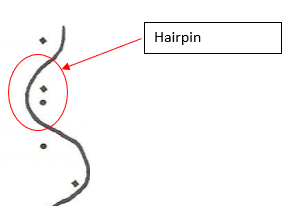
Hairpin – Only found in slalom courses. A vertical combination of gates to mix up the rhythm of a course. Comprised of two gates set vertically on top of one another, racers must make two quick turns in order to navigate successfully.
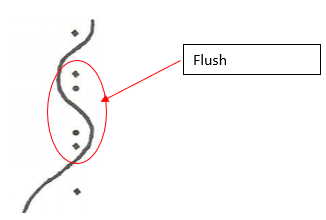
Flush – Just like a hairpin but instead of two turns, contains three or more gates stacked vertically on top of one another.
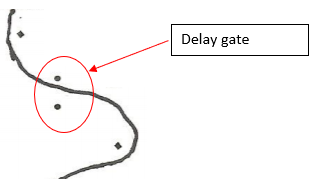
Delay – Another combination type and rhythm changer. When two gates are set to create an elongated turn, skied around on the same side.
Straddle – Usually occurring in slalom, straddling is when a gate goes in between a skier’s legs. Straddling is one of the most common form of disqualifications in ski racing.
Hiking – After missing a gate skiers have the opportunity to hike up the hill to the point where they missed the gate. They can then continue their run. Allowed in slalom, not in any other event (GS, SG or DH).
Other Terms
Brushes – Nylon brush markers used alone or with gates in training courses to set the line.
Stubbies – Knee-high gates used in training courses
Inspection – A period of time before the race where athletes are allowed to slowly slide through the course and get an initial look. Racers use inspection to scope out the placement of the gates, their line, the terrain, any rhythm changes, and get a plan of action before their run.
The Flip – Used in USSA and World Cup races (not used in WIJARA races). After the first run of slalom, GS, and combined, the top 30 finishers run in reverse order for the second run. Therefore, the racer that finished in position 30 after run 1 will run first, and the racer who won the first run will run 30th. In USSA, racers outside the top 30 in the first run go after those in the top 30. In World Cup, racers outside of the top 30 do not race a second run.